

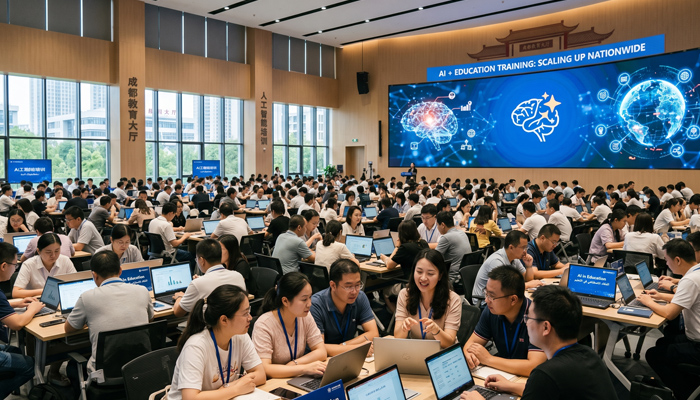
China announced in April 2026 the launch of the AI + Education Action Plan as a national framework to accelerate the integration of artificial intelligence into the education system and to build a more future-oriented, intelligent, and inclusive education model. The plan states that it is aligned with China’s broader goal of building a “strong education nation” by 2035, and that it follows key principles such as learner-centered development, prioritizing competencies and skills, application-oriented implementation, and ensuring that intelligent technologies are used in a beneficial and responsible way. It aims to create a new form of smart education based on human-machine collaboration, the integration of virtual and physical learning environments, and broad access to learning opportunities, while balancing mass education with individualized development, knowledge transmission with capability building, and technological application with humanistic care.
The plan sets a phased objective that by 2030, a basic pattern of deep integration between artificial intelligence and education should be established, together with a new education system that is more open, flexible, and better suited to the intelligent era. This includes strengthening talent cultivation, improving smart education resources, expanding real-world applications, and building an institutional and innovative environment in which AI becomes an integral part of education rather than merely a supporting tool.
The action plan identifies four major lines of work for the period of China’s 15th Five-Year Plan. The first is strengthening AI talent development and improving AI literacy across society by building an education framework that spans all levels of schooling and society as a whole. At the basic education stage, the plan calls for offering AI courses adequately and effectively, while stimulating curiosity, innovative thinking, and the ability to solve complex problems. In higher education, it promotes including AI in general foundational curricula, encouraging interdisciplinary integration, and optimizing academic structures to prepare high-quality talent capable of innovation in the intelligent era. In vocational education, it calls for the intelligent upgrading of traditional industry-related majors and for the cultivation of highly skilled talent able to adapt to industrial transformation. In lifelong education, the plan calls for developing high-quality learning resources for different groups and ensuring equal opportunities to learn AI through flexible forms such as micro-courses and micro-credentials, helping learners update their knowledge and skills and achieve higher-quality employment.
The second major line of work is the deep integration of AI with education. In this vision, AI is not treated only as a subject to be taught, but also as a tool for reshaping teaching, learning, assessment, and educational management. The plan supports the development of smart teaching models, better allocation of educational resources, stronger digital learning environments, and more efficient teaching and learning through structured use of intelligent technologies. In this sense, AI is positioned as a driving force for pedagogical and institutional innovation across schools, universities, vocational institutions, and lifelong learning systems.
The third major line of work focuses on building the foundational environment and enabling capacities required for smart education, including the development of resources, platforms, data systems, and standards needed for safe, broad, and effective AI implementation in education. It also involves building an integrated innovation ecosystem that supports experimentation, application, and scaling, and that links education, research, industry, and data governance so that AI becomes embedded in the wider infrastructure of education reform.
A particularly important training-related aspect of the plan is its requirement to implement a digital competency improvement project for teachers, including system-wide recurring training, capacity assessment, and reform of evaluation mechanisms, in order to encourage teachers to use intelligent technologies in practice and to innovate in how they apply them. The accompanying official reporting also makes clear that the plan is intended to build a comprehensive AI literacy system across all levels of education and throughout society, which means that training and reskilling are not secondary features, but core components of the national implementation strategy.
According to the official press briefing, the plan is organized into six sections and provides an integrated arrangement for AI talent cultivation, application innovation, foundational environment building, and ecosystem development. In that sense, it is not limited to introducing new tools into education, but instead seeks to redesign education itself so that it can better prepare people for work and life in the age of artificial intelligence
