

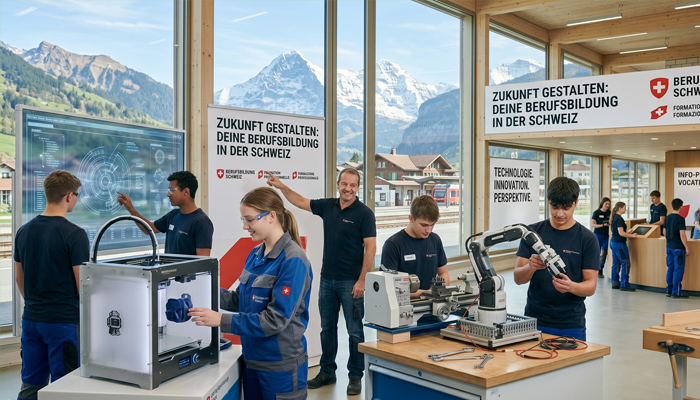
As shown by the report on the attractiveness of vocational education and training, approved by the Federal Council on 6 May 2026, Swiss vocational education and training is in good health. However, to continue attracting young people over the long term, it needs targeted updates.
Vocational education and training is a pillar of the Swiss education system: it enables a large number of young people to enter the labor market and offers long-term prospects. Furthermore, it can count on strong support from the economic world and is highly valued both at home and abroad. At the same time, it competes with other educational pathways and must adapt to changing preferences and social and technological developments.
For this reason, in 2024 the State Secretariat for Education, Research and Innovation (SERI) launched the “Attractiveness of Vocational Education and Training” project. The analyses and dialogue with the economic sector, the cantons, and other partners confirm the strengths of the system, but also highlight the need for action, particularly regarding the ability to attract talented young people, access to the labor market with an upper secondary level qualification, the updating of professional education, and the role of host companies.
Based on the findings, at the 2025 national summit on vocational education and training, the Confederation, the cantons, and organizations of the working world defined seven priorities for the implementation of as many measures. The latter concern aspects such as strengthening workplace training, developing the federal vocational baccalaureate, digitalization, artificial intelligence, and optimizing the process of choosing a profession and career. It is also necessary to clarify certain regulatory issues, strengthen professional education, and improve communication regarding vocational education and training.
From 2026, the measures are being implemented within the framework of the “Attractiveness of Vocational Education and Training” roadmap, which is part of the “Vocational Education and Training 2030” initiative. The roadmap offers a well-structured and long-term reference framework. The Tripartite Vocational Education and Training Conference monitors implementation, while periodic reports allow for a continuous assessment of the progress of work.
The report in fulfillment of postulate 22.4202 by National Councillor Philippe Nantermod and the measures initiated fully meet the requests formulated in the postulate. The collaboration between the Confederation, the cantons, and organizations of the working world ensures that vocational education and training can continue to play its central role in the Swiss education system, adapting to changes in the social, economic, and technological context
Report link https://www.sbfi.admin.ch/fr/publication?id=iUVNgwwsZhMr
