

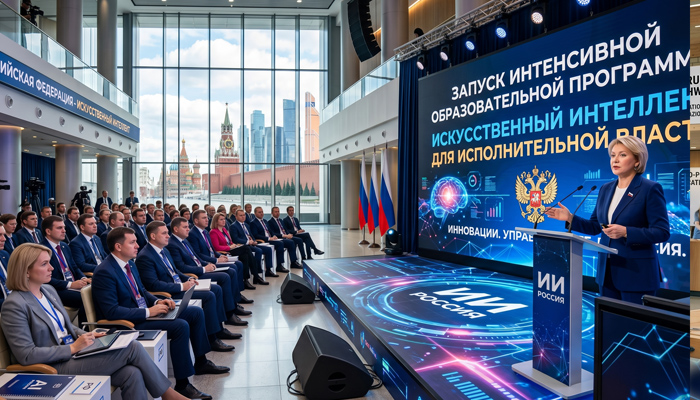
ULAN-UDE – On Friday, June 5, an intensive educational program on Artificial Intelligence applications was launched for local administration officials and executive branch personnel. The event was organized by the Higher School of Public Administration (HSPA) of the Russian Presidential Academy of National Economy and Public Administration (RANEPA), in cooperation with the Academy’s regional branch in the Republic of Buryatia. The program aims to equip administrative and project teams with AI tools, enabling them to leverage these skills to automate routine tasks.
Aldar Gulgenov, Deputy Chairman of the Government of the Republic of Buryatia and Head of the Administration of the Head and Government of the Republic, highlighted the critical importance of integrating AI technologies. He emphasized that the intensive course would showcase successful case studies from other regions that could be adapted and implemented in Buryatia, noting that the HSPA curriculum is specifically tailored for municipal and local government employees.
“I urge all attendees to engage fully with today’s training,” Aldar Gulgenov stated. “This intensive program is designed to prepare administrative and project teams for the practical application of AI tools, aligning and integrating them with the regional priorities of the Republic of Buryatia and the Ulan-Ude urban agglomeration. Dear colleagues, today we will review real-world cases and successful practices from other regions—experiences that we can and must utilize. Modern, effective local administration demands the comprehensive deployment of advanced digital technologies, and these tools are being actively introduced across all sectors of public governance. The examples are numerous; these are functional, real-world projects, not merely pilot concepts. We have our own ideas that we can develop and shape into a ready-to-use product during today’s workshop sessions. In a week, we will reconvene to evaluate the projects proposed today. I am confident this will yield tangible results.”
Irina Smolyak, Deputy Chairman of the Government of the Republic of Buryatia and Head of the regional Project Office, focused on the diverse applications of AI, including drafting responses to citizen inquiries and complaints, as well as automating the generation of terms of reference for government procurement, contracts, and financial estimates.
“We have already begun implementing AI technologies in the Republic of Buryatia,” Irina Smolyak stated. “Specifically, a contract was signed two days ago with Sberbank to provide an AI-powered assistant to thousands of teachers, particularly those in remote residential areas. Yesterday, teachers underwent training on how to interact with this technology, which will assist them in lesson preparation and grading assignments. Furthermore, in collaboration with the social protection sector, we recently launched an assistant system for new parents. We are currently developing several other pathways to maximize the benefits of AI.”
Ivan Laptev, Program Director of the Digital School of Public Administration at RANEPA’s Higher School of Public Administration, explained that the training would focus primarily on practical skills that participants could begin applying from day one.
“We have brought you a wealth of practical skills and projects that have already been successfully implemented across various regions of the Russian Federation,” Ivan Laptev said. “We now possess extensive federal-level experience in executing such initiatives. Among other things, we will demonstrate and explain neural networks that you can integrate directly into your daily workflows.”
Artyom Chalenko, an expert at the Digital School of Public Administration at the Presidential Academy, added that the training aims to output five specific projects that participants can execute using the knowledge and skills acquired during this intensive course.
“The desired outcome of our activity today is five projects created under our expert guidance, which you will bring to final implementation shortly,” Artyom Chalenko explained. “These projects will not require expensive development or massive specialized teams. It only requires you, as officials, to identify the nature of the workflow and the specific operations that can be optimized and automated, or delegated to AI through the services and platforms we will present to you today.”
Vitaly Bulgator, Director of the Presidential Academy’s regional branch in the Republic of Buryatia, noted that “the program is purely practical in nature. Its deliverables include a set of tested, customized prompts for Russian AI platforms, along with methodological materials and a checklist to ensure the safe use of AI.”
The program placed special emphasis on prioritizing Russian AI platforms, safeguarding personal data and official information, and strictly adhering to the National Code of Ethics in Artificial Intelligence.
Upon completion of the training, participants will receive professional development certificates for the intensive educational course “Artificial Intelligence Applications for Executive Authorities,” issued by the Higher School of Public Administration of the Presidential Academy (RANEPA).
